Improving receivables management with clear payment terms
This article explains improving receivables management with clear payment terms in the context of German receivables management. It is written for companies, self-employed professionals, accounts receivable teams and creditors that need a clear, documented next step. Fortis Inkasso GmbH & Co. KG can support professional debt collection processes; the article does not replace case-specific legal advice.
Starting point: Improving receivables management with clear payment terms
An unpaid invoice is rarely an isolated event; it is usually the result of several small gaps in the process. This article starts exactly there: Improving receivables management with clear payment terms. The aim is an approach that avoids escalation yet stays documented well enough to hold up. That keeps the case understandable for colleagues with no prior knowledge of it.
A uniform starting point for every case helps: same checks, same order, same filing. That makes processing predictable and the results comparable. In receivables management, a documented standard process pays off more than a chain of individual decisions. This care costs minutes and saves days if the matter is ever disputed.
Requirements and documents
The documents should be assembled so that a third party understands the case without explanation. That means the contractual basis, the invoice, proof of performance or delivery, the reminder history with dates and complete debtor details. The earlier this point is clarified, the less time enforcement costs later.
In ongoing business relationships, filing by case rather than by customer works better. With several invoices open, it stays clear which document belongs to which amount. KPIs such as DSO and the overdue share make the effect of process changes visible. The link to the subject of this article is direct: Improving receivables management with clear payment terms.
Step-by-step approach
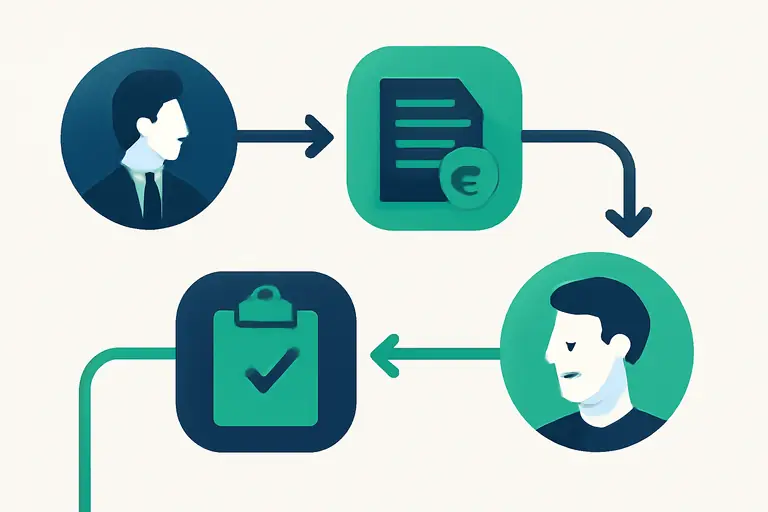
The approach follows the calendar rather than instinct. Day one after the due date: check incoming payments. Days three to five: friendly reminder. Days ten to fourteen: formal reminder with a final period. After that period: decide on escalation. A fixed cycle is more effective than a review that only happens when someone asks for it.
Switching channel helps: what fails by email is often resolved in a few minutes by phone. The result of the call is then confirmed in writing. A short written procedure is followed in daily practice more reliably than an extensive manual. The effort is one-off; the benefit repeats with every case.
Common mistakes and risks
The most common mistake is waiting. Reacting only after months costs information, contacts and, in an insolvency, part of the dividend. Equally critical are vague deadlines such as "immediately", missing proof that the invoice was received, and reminders without an itemised breakdown. What is prepared properly at this stage shortens every subsequent step.
The limitation period is often underestimated as well: the standard period is three years and starts at the end of the year in which the claim arose. Overlooking it means losing enforceable claims for no reason. An annual review of whether the defined stages still fit the customer base is worthwhile. The thread running through it stays the same: Improving receivables management with clear payment terms.
When Fortis can be involved
Bringing in a service provider makes sense as soon as a case is only being administered internally rather than actually worked. Fortis Inkasso GmbH & Co. KG can take over at this point, review the documents and run the further contact in a structured way. A short note in the system replaces any later reconstruction from memory.
No promise about the outcome is possible, and this article does not replace case-specific legal advice. It does show which steps should sensibly be completed before instructing an agency. Effective receivables management combines prevention before the due date with consistent escalation after it. In practice, reliability pays off faster than pressure.