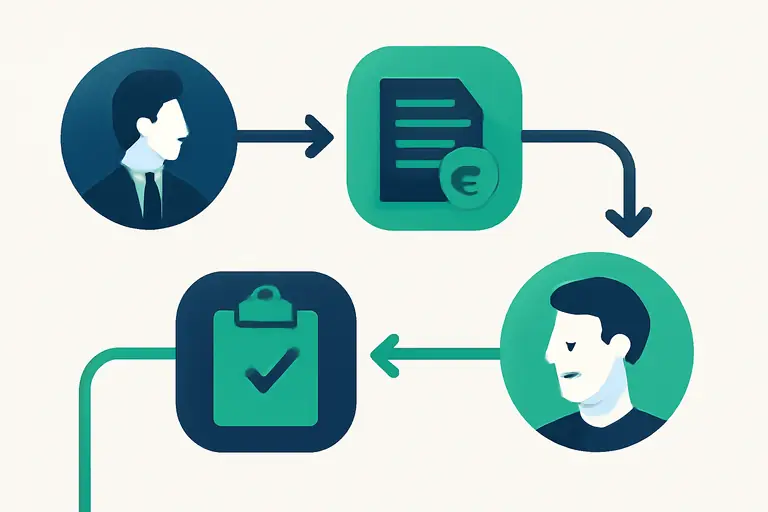
Receivables management up to the Mahnbescheid (German court order for payment): how to define escalation paths

Reviewed: 2026-07-26. “Receivables management up to the Mahnbescheid (German court order for payment): how to define escalation paths” is mainly a matter of data quality, evidence and consistent deadlines. Businesses should separate undisputed payment arrears from genuine clarification cases. The German court payment-order procedure is not a substitute for evidence review where a serious dispute exists. This avoids unnecessary escalation without allowing valid receivables to remain inactive. The contract and German law remain decisive.
When a Mahnbescheid is appropriate
A Mahnbescheid (German court order for payment) forms part of the gerichtliches Mahnverfahren under sections 688 et seq. ZPO (German Code of Civil Procedure). It is mainly suitable for quantified monetary claims where a substantiated objection is not expected. The court does not examine the merits when issuing it. If the respondent objects, the matter may move to ordinary civil litigation. Without an objection, a Vollstreckungsbescheid (German enforcement order) may follow. Party details, legal basis, amount and address must be accurate. For the specific issue “how to define escalation paths”, this requirement should be recorded in the review note with its date and supporting evidence.
For the focus “how to define escalation paths”, a short review note should record the facts, the rule applied and the legal or data date on which the statement is based. The contract, invoice, evidence of performance and communications should be brought together in one case file. In “how to define escalation paths”, this control determines whether the standard workflow applies or an individual review is required.
Choose between collection, payment-order proceedings and litigation
Out-of-court debt collection is useful where communication, a payment arrangement or structured clarification may still work. The gerichtliches Mahnverfahren (German court payment-order procedure) is efficient for a quantified monetary claim that is likely to remain uncontested. Ordinary litigation is usually more suitable where the contract, performance, defects, set-off or amount is seriously disputed. The decision depends not only on costs but also on evidence, jurisdiction, limitation, enforceability and the debtor’s economic position. It should be documented before any deadline expires. For “how to define escalation paths”, the workflow should continue only after ownership, deadline and the exception route are clearly set in the system.
For recurring cases, use a checklist of mandatory fields and a four-eyes review. A green status should be assigned only when the required evidence is available; otherwise the case should be routed deliberately for clarification. For “how to define escalation paths”, quality control should reconcile the balance and underlying entries once more against the original evidence.
Validate the claim before escalation
Before any reminder or handover, the creditor should reconcile the creditor and debtor identities, contract, performance, invoice amount, due date, payments, credit notes and objections. The company name and legal form must match the actual contracting party. For ongoing contracts, termination, term and billing period must be checked. Only the balance remaining after all payments and credits may be pursued. A short internal approval step prevents non-existent claims, duplicate handling and unnecessary costs. In “how to define escalation paths”, this control determines whether the standard workflow applies or an individual review is required.
The workflow should move standard cases quickly while automatically routing disputes, insolvency, data-protection or limitation risks out of the standard path. Human review remains necessary where the data or legal position is not clear. The outcome for “how to define escalation paths” should record the current balance, next date, reason for the decision and responsible person. Receivables management should automate standard cases while deliberately routing exceptions for review.
What suspends or restarts limitation
A payment reminder, Mahnung or mere instruction of a collection provider does not generally suspend limitation. Serious negotiations may suspend it under section 203 BGB (German Civil Code). Timely court measures, particularly service of a Mahnbescheid (German court order for payment) under section 204 BGB, may also suspend it. An acknowledgement or partial payment may restart the period under section 212 BGB. Effect, timing and evidence require individual review; an internal reminder shortly before year-end is not a reliable protective measure. For “how to define escalation paths”, quality control should reconcile the balance and underlying entries once more against the original evidence.
Before escalation, reconcile bank entries, credit notes, returns, partial payments, objections, insolvency signals and limitation dates. An item shown as open in accounting is not automatically due or undisputed; the decision must follow from the complete file. For the specific issue “how to define escalation paths”, this requirement should be recorded in the review note with its date and supporting evidence.
Which debt collection costs may be recoverable
The remuneration agreed between the creditor and the debt collection provider depends on the engagement. It may be claimed from the debtor only as default damage where the legal requirements are met and the expenditure was necessary. Section 13e RDG (German Legal Services Act) generally limits recoverable collection costs to the remuneration a lawyer could charge for the same work under the RVG (German Lawyers Remuneration Act). Court, service and enforcement costs arise separately. It is therefore inaccurate to describe collection as always free for either party. The outcome for “how to define escalation paths” should record the current balance, next date, reason for the decision and responsible person.
The process ends with a documented decision stating the current balance, next deadline and responsible person. Fortis Inkasso GmbH & Co. KG can then handle suitable undisputed claims out of court, without implying a guarantee of recovery or legal outcome. For “how to define escalation paths”, the workflow should continue only after ownership, deadline and the exception route are clearly set in the system.
Sources
Primary sources and official information used in this article.
- § 688 ZPOGesetze im Internet / Federal Ministry of Justice
- Online-Mahnantrag der Justizonline-mahnantrag.de
- § 204 BGBGesetze im Internet / Federal Ministry of Justice
- § 286 BGBGesetze im Internet / Federal Ministry of Justice
- § 203 BGBGesetze im Internet / Federal Ministry of Justice
- § 212 BGBGesetze im Internet / Federal Ministry of Justice
- § 13e RDGGesetze im Internet / Federal Ministry of Justice