Receivables management outsourcing: opportunities, costs and control points

Reviewed: 2026-07-26. “Receivables management outsourcing: opportunities, costs and control points” is mainly a matter of data quality, evidence and consistent deadlines. Businesses should separate undisputed payment arrears from genuine clarification cases. Outsourcing is a process and capacity decision, not simply a price question. This avoids unnecessary escalation without allowing valid receivables to remain inactive. The contract and German law remain decisive.
Draw the right line between internal and external work
Outsourcing is not justified by claim value alone. The comparison should include case volume, age, dispute rate, languages, internal staffing cost, systems, handling time, legal capability and reporting. The business should retain control of customer relationships, clarifications and approvals, while an external provider may handle standard recovery, specialist work and scale. Service levels should define data transfer, response times, instalments, settlements, court action, reporting and return. The creditor remains responsible for accurate source data. For the specific issue “opportunities, costs and control points”, this requirement should be recorded in the review note with its date and supporting evidence.
For the focus “opportunities, costs and control points”, a short review note should record the facts, the rule applied and the legal or data date on which the statement is based. The contract, invoice, evidence of performance and communications should be brought together in one case file. In “opportunities, costs and control points”, this control determines whether the standard workflow applies or an individual review is required.
Check whether a German debt collection provider is reputable
Commercial debt collection services in Germany generally require registration under the RDG (German Legal Services Act). The entry can be checked in the Rechtsdienstleistungsregister maintained by the Bundesamt für Justiz (German Federal Office of Justice). Other criteria include clear contract and pricing information, reachable contacts, data protection, transparent statements, complaint channels and meaningful reporting. Unsupported "test winner" claims, guaranteed recovery rates or pressure to sign immediately are not proof of quality. The service and cost model must fit the portfolio. For “opportunities, costs and control points”, the workflow should continue only after ownership, deadline and the exception route are clearly set in the system.
For recurring cases, use a checklist of mandatory fields and a four-eyes review. A green status should be assigned only when the required evidence is available; otherwise the case should be routed deliberately for clarification. For “opportunities, costs and control points”, quality control should reconcile the balance and underlying entries once more against the original evidence.
Digital handover without breaks in the data chain
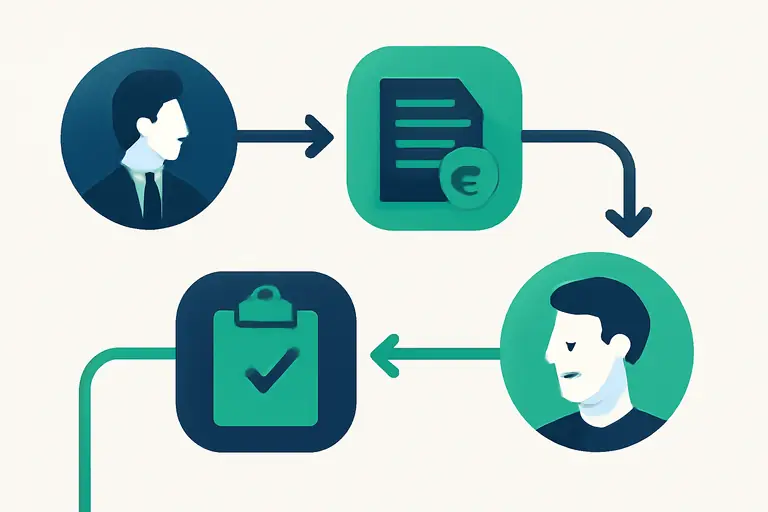
A digital collection handover should include master data, statement of account, contract, invoice, performance evidence, reminders, objections, payments and current contact details. Every file must be clearly linked to the claim. Interfaces are useful for high volume; for smaller portfolios, a well-defined spreadsheet or portal transfer may be sufficient. Mandatory fields, formats, duplicate checks and status feedback should be agreed in advance. Sensitive data should enter the process only through secure channels and role-based access. In “opportunities, costs and control points”, this control determines whether the standard workflow applies or an individual review is required.
The workflow should move standard cases quickly while automatically routing disputes, insolvency, data-protection or limitation risks out of the standard path. Human review remains necessary where the data or legal position is not clear. The outcome for “opportunities, costs and control points” should record the current balance, next date, reason for the decision and responsible person. Receivables management should automate standard cases while deliberately routing exceptions for review.
Which debt collection costs may be recoverable
The remuneration agreed between the creditor and the debt collection provider depends on the engagement. It may be claimed from the debtor only as default damage where the legal requirements are met and the expenditure was necessary. Section 13e RDG (German Legal Services Act) generally limits recoverable collection costs to the remuneration a lawyer could charge for the same work under the RVG (German Lawyers Remuneration Act). Court, service and enforcement costs arise separately. It is therefore inaccurate to describe collection as always free for either party. For “opportunities, costs and control points”, quality control should reconcile the balance and underlying entries once more against the original evidence.
Before escalation, reconcile bank entries, credit notes, returns, partial payments, objections, insolvency signals and limitation dates. An item shown as open in accounting is not automatically due or undisputed; the decision must follow from the complete file. For the specific issue “opportunities, costs and control points”, this requirement should be recorded in the review note with its date and supporting evidence.
Interpret DSO and related metrics correctly
Days Sales Outstanding is commonly calculated as average receivables divided by credit sales, multiplied by the number of days in the period. It indicates capital tied up but can be misleading without seasonality, growth, payment terms and sector context. It should be supplemented by the overdue ratio, share over 90 days, dispute rate, promise-to-pay performance and recovery rate. Metrics need consistent definitions and segmentation by customer, country or product. A falling DSO accompanied by higher write-offs would not be a success. The outcome for “opportunities, costs and control points” should record the current balance, next date, reason for the decision and responsible person.
The process ends with a documented decision stating the current balance, next deadline and responsible person. Fortis Inkasso GmbH & Co. KG can then handle suitable undisputed claims out of court, without implying a guarantee of recovery or legal outcome. For “opportunities, costs and control points”, the workflow should continue only after ownership, deadline and the exception route are clearly set in the system.
Sources
Primary sources and official information used in this article.
- Rechtsdienstleistungsgesetz (RDG)Gesetze im Internet / Federal Ministry of Justice
- RechtsdienstleistungsregisterJustice Portal of the Federation and the Länder
- GDPR (Regulation (EU) 2016/679)EUR-Lex
- § 13e RDGGesetze im Internet / Federal Ministry of Justice
- § 286 BGBGesetze im Internet / Federal Ministry of Justice